
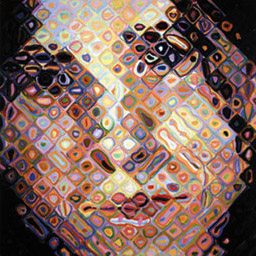
I’m interested in the art of Chuck Close. His early portraits are disarming, closely detailed examinations of individuals faces at such painstaking depth that nothing is left to the imagination. In fact, they are called “photorealism.” And then, in his later work, the grids take over, in which the faces are dissected into small pieces, almost as if they are viewed through water droplets: get too close, and they are just boxes of color; step away, and the face is there, with its unique detail and expression. How does he do that?
And why? Why a lifetime of dissecting faces, many of them over and over? Indeed, he spends a great deal of time painting his own face, over the years, as it changes and ages. It’s interesting to read that Close suffers from the neurological condition prosopagnosia, or face-blindness, which prevents him from recognizing faces. Irony.
There’s a much to study about the artist who spends his days painting parts of faces. He employs others to set up his grids, to do some of the painting: does that make the work any less his own? What about the other things people say about him, that he takes advantage of his students, perhaps harasses the assistants in his studio? Should we not look full-on at his work when these things have been said? If he sees one of his subjects on the street, does he recognize her? Does he “see” his subject at all, or just the inch he is painting at each moment?



 When I was a kid and my father would bring me into the city for a visit to a museum or to the theater, we’d take the train and then the subway, using those old tokens. I still have one or two somewhere, in the bottom of my coin bottle. I couldn’t get rid of them. Even though the MetroCards are wonderful conveniences (but they also have allowed the MTA to easily and substantially increase prices over the years), the tokens were cool.
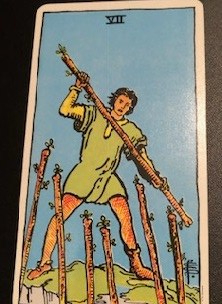 I did pull some cards on New Year’s Day, and an interesting one popped up that really does shed some light on why I’m not skipping down the street these days. The Seven of Wands is depicting one man’s battle against many, which can seem overwhelming, or even pointless. Symbolically, it represents an ongoing struggle to decide whether to stand and fight for something – against seemingly overwhelming odds – or wait for another, better opportunity to fight and win. It’s hard to know when you’re tangled up in the daily struggle if you’re making the right choices.
 Cassie Thornton's Life, Loves, and the Tarot